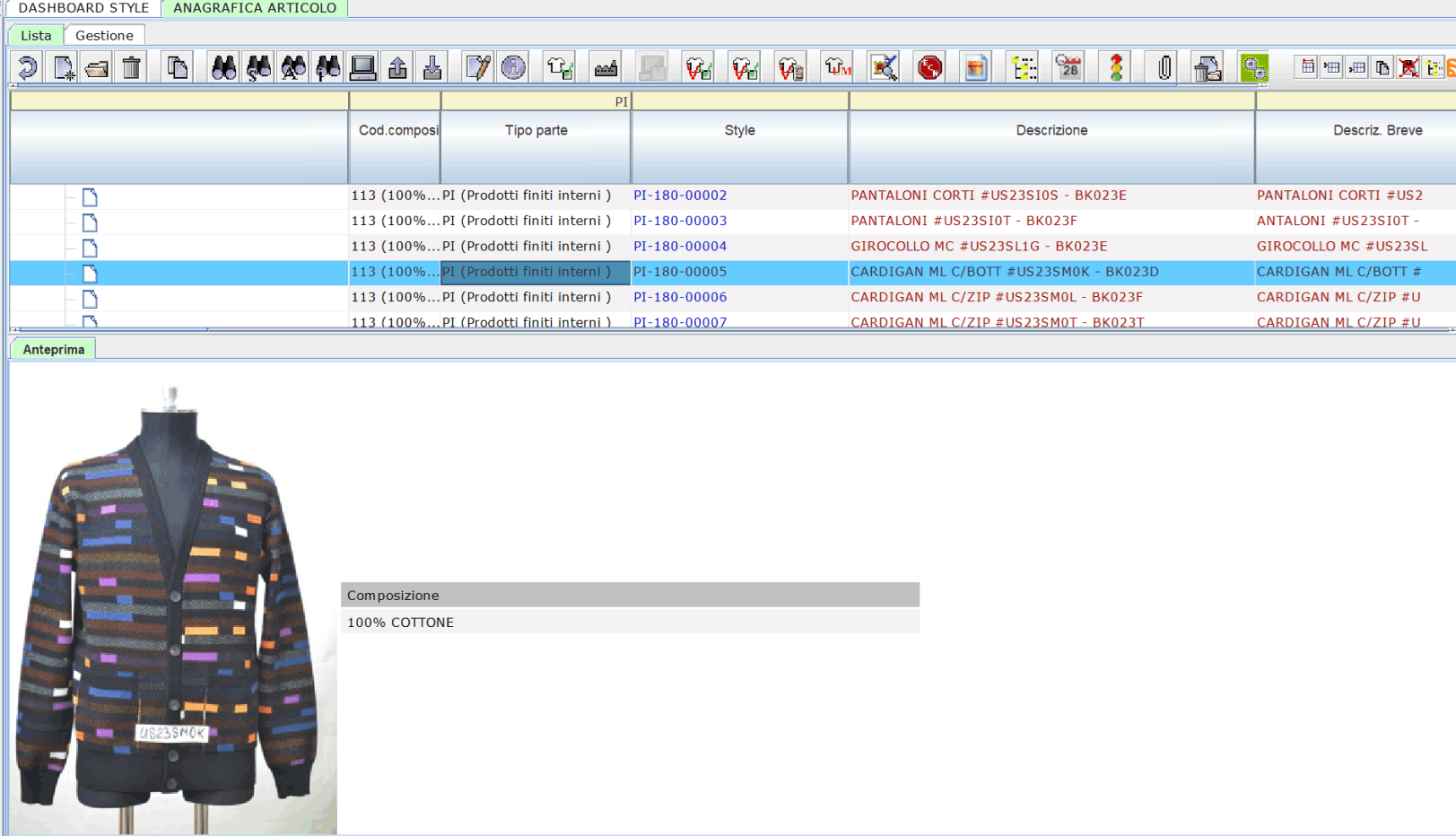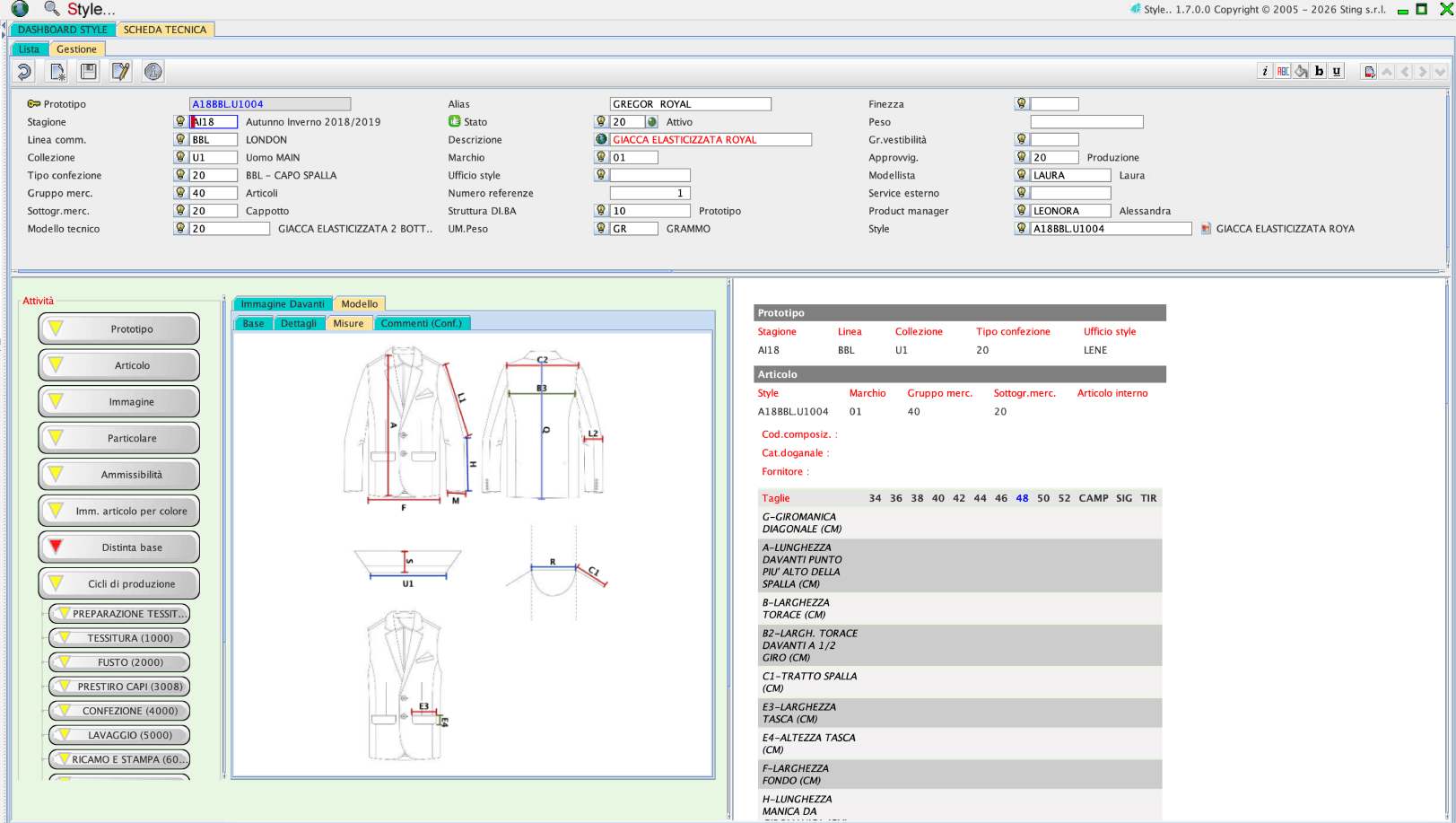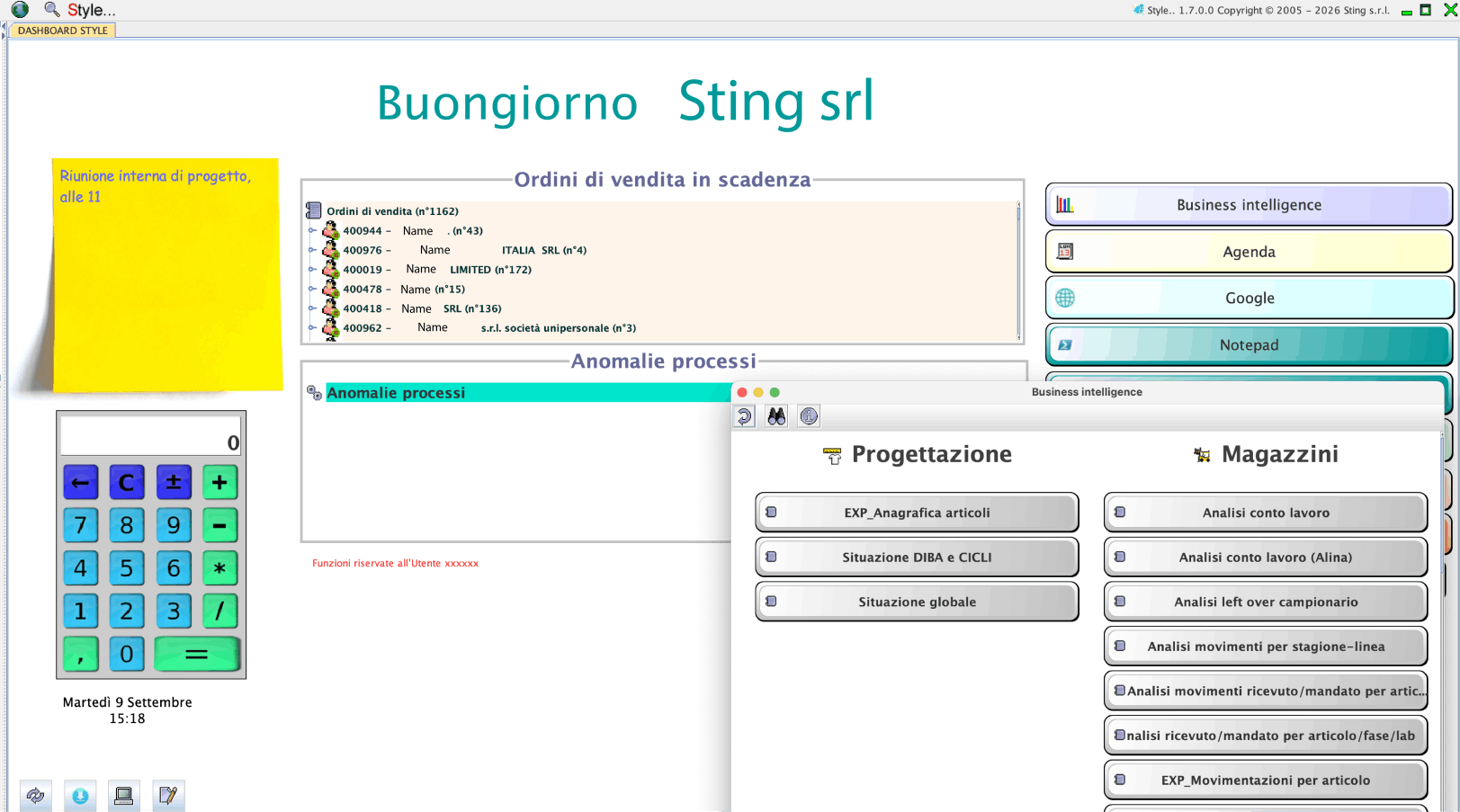
- Style.. manages the pattern-making process by using the model as the starting element of the product code, extended into its sales form. It is in the model master data that the sketch is linked to the design phase, defining the admissibility of colors and compositions.
- Style.. allows any variation in the sketch: dimensions (measurements) can be modified, details can be added within the sketch, and, starting from a basic sketch (garment type), all the desired model variants can be generated.
- Style.. enables the management of garment areas as variables of a product. Zooming in on a garment area, applying the desired variant, and dimensioning the new insertion becomes a simple and rational operation; ease of execution is one of the key aspects in the design process with Style..
- Style.. manages collection presentations according to seasonality and commercial lines. Collections allow items to be enabled for color charts (catalogs) and to use collection price lists in different markets with their respective currencies.
- Style.. manages sales with the same operating methods, both internally within the company (sales representatives) and through B2B (agents, stores, trade fair stands, etc.), eliminating the need to use alternative sales collection tools such as traditional agent systems, store systems, or immediate stock sales.
- Style.. enables balancing and online suggestions of missing products and predictable deliveries (A.T.P.) already at the sales order stage. It also allows, as an option, the assignment of production by customer or by warehouse (Strong or Light), enabling online monitoring of deliveries for each individual sales order line.
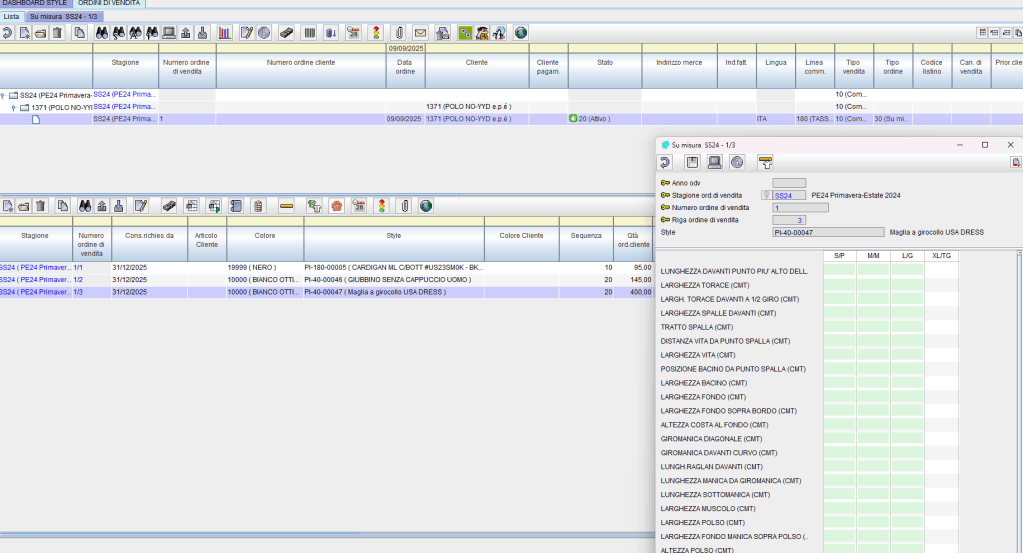
- Style.. supports the management of made-to-measure orders. Already at the order acceptance stage, it is possible to enter the measurement points of the individual concerned, ensuring precise customization management.
- Style.. enables precise management of transport between different workshops. It is equipped with a module for managing scheduled trips, allowing planners to monitor and account for transport times between the various production phases. The transport module supports multiple logistics modes, such as land, water, etc.
- Style.. manages warehouses across different facilities. The various locations within each warehouse allow real-time monitoring of the events affecting products (loading dock locations, ready stock locations, transit locations, etc.).
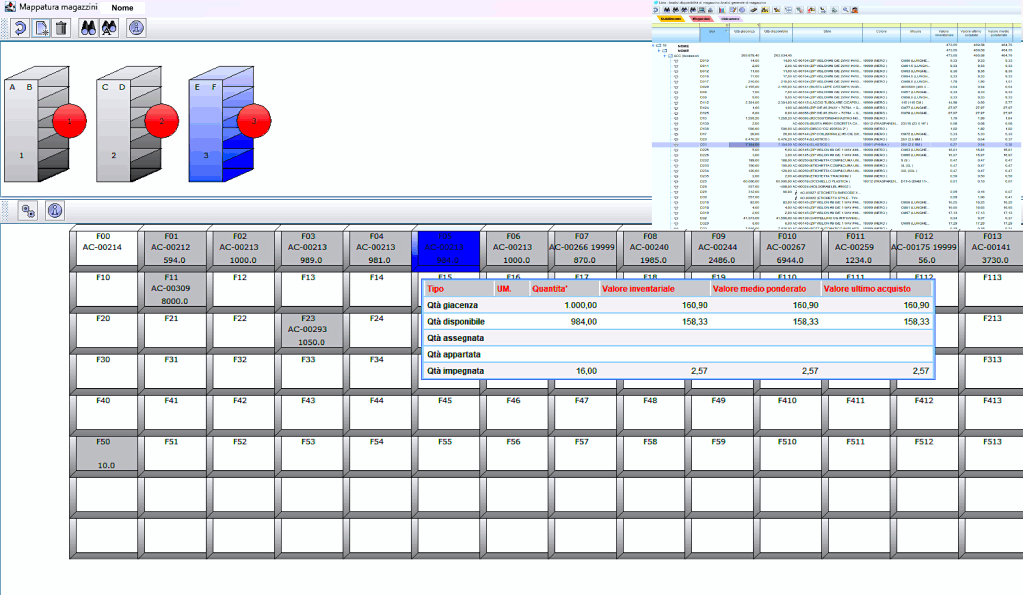
- Style.. supports warehouse mapping. The mapping definition can be customized for Customer Box or Technical Box, allowing goods to be traced within individual boxes before issuing pick lists and guiding the picking route, whether automatic or manual.
- Style.., attentive to the pressing demands of the industry, enables planning across facilities located in different markets. Planning uses finite capacity techniques, applicable both to internal Work Centers (departments, i.e., structured work centers within company facilities or controlled sites) and external Work Centers (workshops, subcontractors, or suppliers managed through open contracts and defined only upon return to the company).
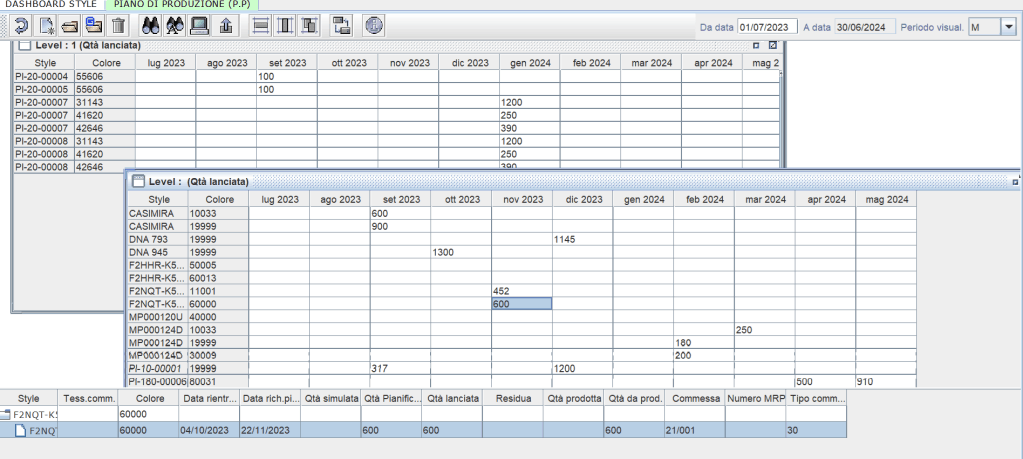
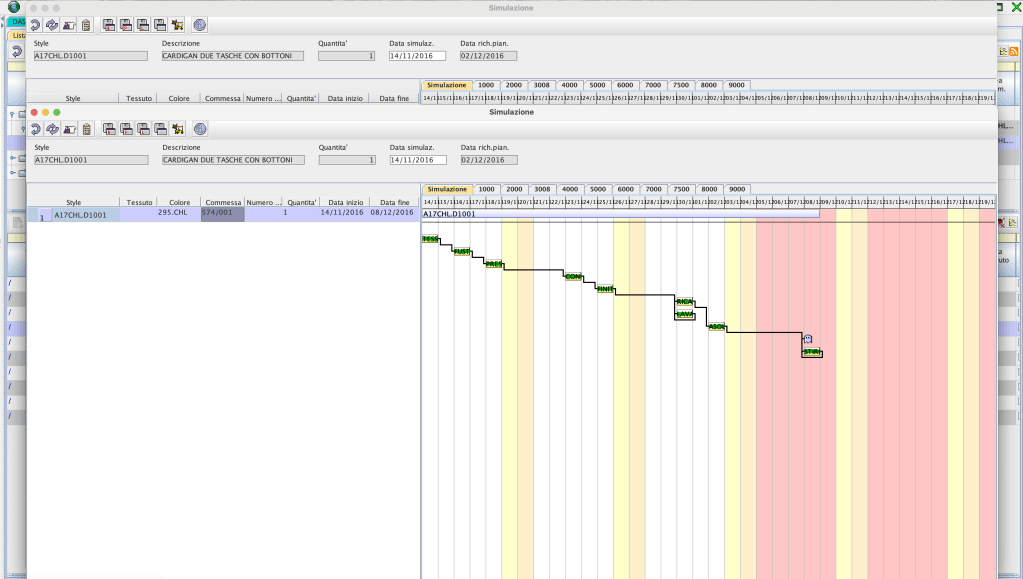
- Style.. allows simulation by production lines or detailed scheduling on individual machines (e.g., looms, straight and circular knitting machines, cut-and-sew, injection carousels, tumbling machines, etc.). Planning or simulation, useful for defining a hypothetical production program, can be performed at multiple levels: the Decision Maker can activate different scenarios using the planning of both semi-finished and finished products.
- Style.. optimizes resource planning by controlling current and future component availability. Already at the sales order request stage, it can prevent foreseeable delays and guide both the planning and scheduling phases in the most effective way.
Style.. simulates planned or hypothetical orders in real time, integrating them with active production orders (program). This functionality provides the planner with an overview of what has been simulated, planned, and already launched. Using production cycles, it is possible to simulate the start and end dates of each individual phase and product level.
Style.. enables planning on production lines, both internal (departments) and external (workshops), allowing an order to be scheduled even without knowing in advance all the involved executors (controlled workshops, subcontractors, or internal departments). It also supports the planner in flexible management of external resources.
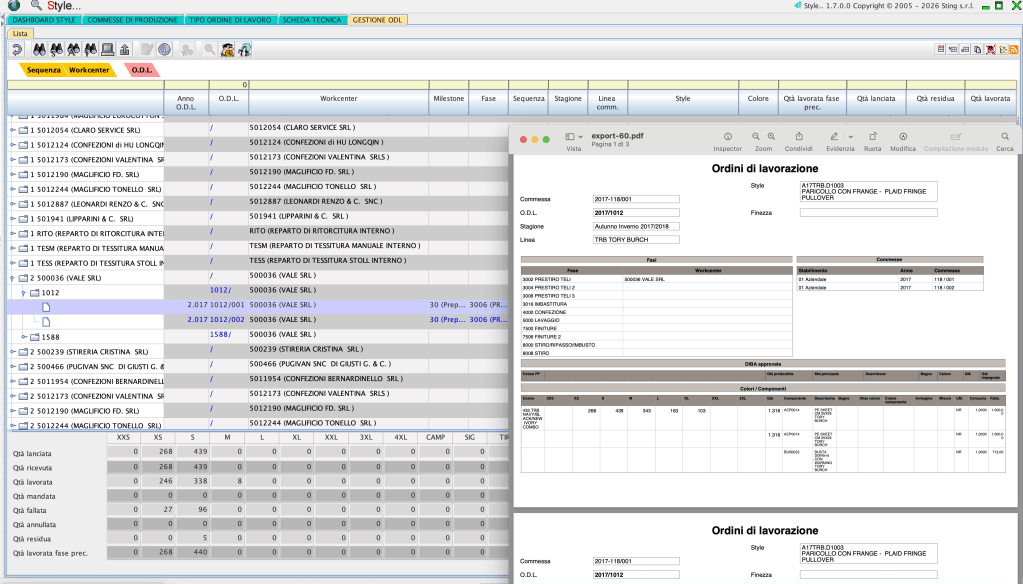
Style.. manages the progress of production phases directly at external workshops (see Technical Data section), allowing online monitoring of production status from anywhere in the world.
Style.. allows distribution of workshop capacities not only based on available hours but also according to the number of pieces to be produced daily, weekly, or monthly.
Style.. manages the initiation of each planning process based on the coverage of required materials, taking into account both stock available in the warehouse and materials already ordered from suppliers.
- Style.. controls production capacities. This functionality allows assigning productive capacities to individual resources (internal or external) per production line, expressed in number of pieces, hours, or shifts, based on the company or workshop calendar.
- Style.. enables advancing production phases in two modes: punctual, phase by phase, or automatic, managing multiple phases simultaneously. The latter mode ensures that what is declared in production is completed to fully utilize the available production capacities.
- Style.. allows online intervention for repositioning production phases. If order analysis highlights anomalies, it is possible to act quickly on each individual phase, modifying its timings or replacing a planned workshop, automatically integrating the new capacity assignments.
- Style.. manages all movements related to shipment creation, using radio-frequency barcode management, web management, and all other integrated functionalities of Style..
- Style.. proposes to manage the design in an integrated way. The production cycles, bills of materials, technical forms, colouring modules and the creation of the catalogues are all available functions included in the design; this advantage will avoid the need and use of other alternative systems linked to the design like the technical form, catalogues and sales books.
- Style.. allows the design of the articles’ structure to have flexible rules on different kind of products, this will enable the firm to work on highly customised environments like Total look. The whole creation with Style will be active with all products with the same management but changeable with different kind of articles type.
- Style.. manages the pattern-making process by using the model as the starting element of the product code, extended into its sales form. It is in the model master data that the sketch is linked to the design phase, defining the admissibility of colors and compositions.
- Style.. allows any variation in the sketch: dimensions (measurements) can be modified, details can be added within the sketch, and, starting from a basic sketch (garment type), all desired model variants can be generated.
- Style.. enables the management of garment areas as variables of a product. Zooming in on a garment area, applying the desired variant, and dimensioning the new insertion becomes a simple and rational operation; ease of execution is one of the key aspects in the design process with Style..
AI Website Generator